Stacked Energy Storage Battery
Stacked Energy Storage Battery
Core Definition
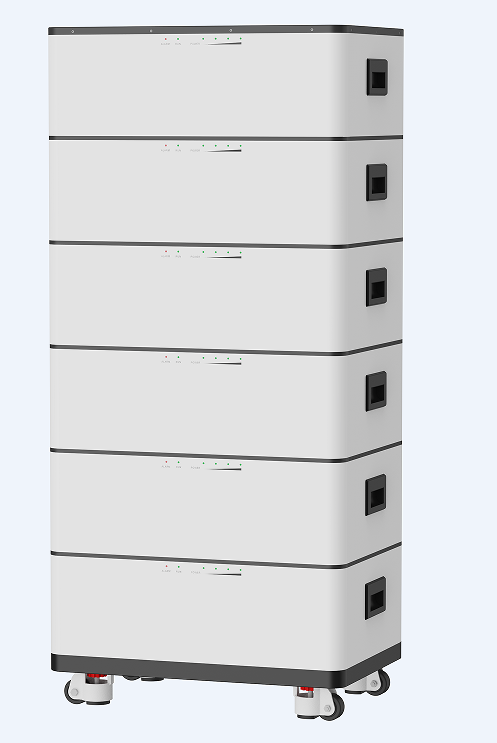
A stacked energy storage battery is a modular energy storage system that stacks multiple individual battery cells or modules vertically (or in layers) to achieve higher voltage, larger capacity, and increased energy density, compared to traditional horizontal arrangement.
Key Structural Features
- Layered modular design: Individual battery cells/modules are stacked along the vertical axis, connected in series/parallel to meet specific capacity and voltage requirements.
- Space optimization: Dense stacking reduces the overall footprint of the battery system, making it ideal for utility-scale energy storage projects with limited land.
- **Scalability: Users can adjust the number of stacked layers to easily expand the system's total energy capacity, adapting to different application scenarios.
Common Applications
1. Grid-scale stationary energy storage (peak shaving and frequency regulation for power grids)
2. Commercial and industrial backup power
3. Residential energy storage systems (with limited installation space)
Working Principle of Stacked Energy Storage Battery
Stacked energy storage batteries work based on the fundamental electrochemical energy conversion principle common to rechargeable batteries, with additional system design logic for stacked modular architecture:
1. Basic electrochemical reaction: Each individual cell in the stack realizes energy storage and release through reversible redox reactions: lithium ions (for lithium-ion stacked batteries, the most common type) shuttle between the positive and negative electrodes during charging/discharging to convert between electrical energy and chemical energy.
2. Series-parallel connection for target performance: By stacking multiple cells/modules and connecting them in series to increase the total output voltage, and in parallel to boost the overall capacity, the system can meet the voltage/capacity requirements of different application scenarios.
3. Modular energy management: A unified Battery Management System (BMS) monitors and regulates the voltage, temperature and state of charge (SOC) of each stacked cell in real time, ensuring consistent performance across the whole system and improving safety and cycle life.
Key Advantages of Stacked Energy Storage Batteries
1. Higher energy density
The vertical stacking design eliminates redundant spacing between modules compared to traditional horizontal layouts, enabling more energy to be stored in the same footprint. This reduces the overall land occupancy for the energy storage system, which is especially valuable for grid-scale projects and space-limited scenarios.
2. Flexible scalability
It supports modular expansion: users can directly adjust the number of stacked cell layers to match required capacity and voltage without major redesign of the system framework, lowering the threshold for capacity expansion for different application needs.
3. Improved thermal management performance
The compact stacked structure simplifies the design of integrated cooling systems, enabling more uniform heat distribution across cells. This helps maintain consistent operating temperature, reduces performance degradation from uneven heating, and extends the overall cycle life of the battery system.
4. Lower system cost
Modular stacked design simplifies production and assembly processes, reducing manufacturing and installation labor costs. It also allows for easier maintenance—faulty individual modules can be replaced directly without overhauling the entire system, lowering post-operation maintenance expenses.