Application of frequency converters in synchronous fans
01 Introduction to Fans
Fans include negative pressure fans, circulating fans, centrifugal fans, Roots blowers, boiler induced draft fans, and copper furnace blowers, etc. They have significant load inertia and are mechanical devices used to transport gas. They convert the power of a motor into mechanical energy. The fan's airflow is directly proportional to the motor speed; that is, changing the motor speed changes the fan's airflow. The above are common asynchronous fans. In practical applications, asynchronous motors have high current and noticeable mechanical resonance in low-frequency standby mode. In recent years, synchronous motors have been widely used in various applications. Compared to asynchronous motors, synchronous fans have lower current, higher torque, significant energy-saving effects, and lower motor noise at low frequencies, with even more significant advantages in high-power applications.
Requirements for Inverter Applications:
Permanent magnet synchronous motors require a corresponding controller for drive. The inverter must operate smoothly at low frequencies and have multiple protection functions for the motor. When the airflow is small, the motor's temperature rise and noise must not exceed the allowable range.
02 System Requirements
☆ On-site and DCS switching control;
☆ Rapid start-up;
☆ The damper opening current instantaneously increases to 1.5 times the rated current or even more and lasts for about one minute;
☆ Long-term low-speed operation requires high low-frequency torque and smooth operation.
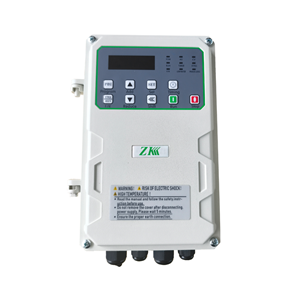
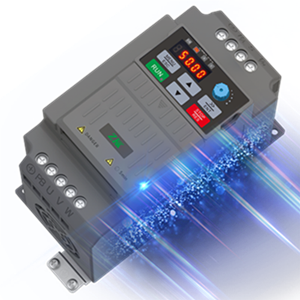
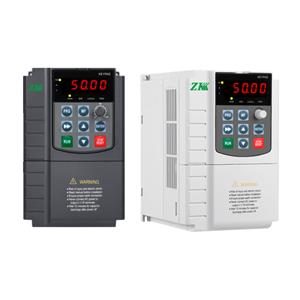
03 ZK300 Permanent Magnet Synchronous Frequency Inverter Features
1. The control core adopts a high-performance DSP processor;
2. Vector control algorithm and intelligent control technology;
3. Advanced field weakening control algorithm to improve high-speed motor performance;
4. Power components adopt surface mount technology, featuring excellent heat dissipation structure design and temperature monitoring function, greatly improving the controller's adaptability to high-temperature environments;
5. Reliable and comprehensive overheat and overcurrent protection functions, employing a heat calculation algorithm to ensure reliable operation;
6. Parameters can be flexibly adjusted to match motors from different manufacturers.
04. Features and Advantages of the Solution
☆ The ZK300 frequency converter's variable frequency control system has speed control capabilities. In synchronous SVC vector mode, the frequency converter's dynamic response is fast, improving the quality of operation.
☆ The ZK300 frequency converter features a high-performance current vector algorithm, enabling it to achieve high speeds at low frequencies (0.3Hz/150%).
☆ The ZK300 frequency converter has a built-in DC reactor to suppress DC bus voltage fluctuations.
☆ When used with synchronous fans, the ZK300 frequency converter draws less current at both high and low frequencies, resulting in more significant energy savings compared to asynchronous fans, and also produces lower motor noise pollution.
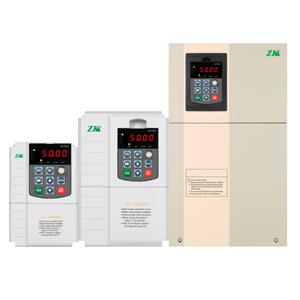
☆ The ZK300 frequency converter's small size facilitates installation in control cabinets, requiring less space in the electrical distribution room.