Specialized frequency converters in power cable tray applications
Composition and Working Principle of a Powered Cable Laying-out Machine:
The powered cable laying-out machine lays out two (or more) cables. The cables pass through a balance bar machine, and the position of the balance bar determines whether the cable laying-out machine rotates forward, reverses, or stops at zero. After passing the balance bar, the cables finally enter the stranding machine, where the two (or more) cables are twisted together to produce the final product. For example, the network cable we commonly use can be produced using a powered cable laying-out machine.
Functions of a powered wire feeding frame.
The entire powered wire feeding frame should achieve the following: the feedback rod should be able to quickly and accurately find the zero point during startup; stable wire feeding during operation; and accurate wire tension when stopped. The following are the requirements for a powered wire feeding frame from a certain machinery factory: (1) When the swing arm is in the middle, the motor stops (commonly known as the zero point position); (2) When the swing arm is below, the motor reverses, and the maximum frequency does not exceed 5Hz; (3) When the swing arm is above, the motor rotates forward, with a maximum frequency of 30Hz, and the response time must be fast; (4) When the swing arm moves up or down, it should not touch the limit point; (5) When automatically finding the zero point, the swing amplitude should not be too large, and the zero point should be found quickly and accurately; (6) When stopped, the wire should not loosen and should remain taut.
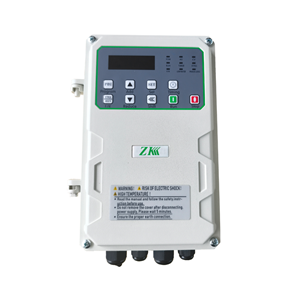
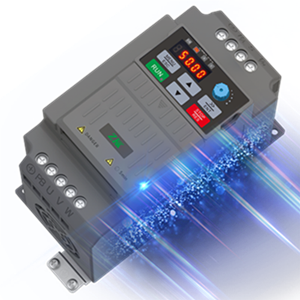
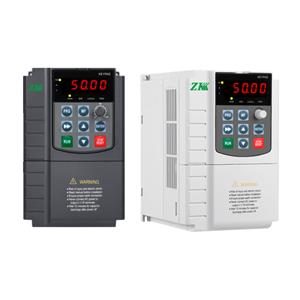
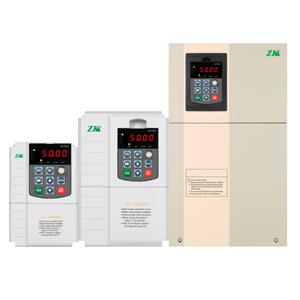
Application of ZK300 in Power Cable Relay Stands
To achieve the functions of the power cable relay stand, the PID function of the ZK300 frequency converter can be used. First, find the zero point of the feedback rod (physical position in the middle; at this time, the PID input can be set to 50%). Connect the feedback rod to the PID feedback. By shifting the feedback rod away from the zero point, forward or reverse rotation is achieved. To achieve other functions, relevant PID parameters (PID gain, PID feedback, etc.) can be adjusted.
In summary, the power wire feeding rack utilizes the PID control function of a frequency converter. Previously, a dedicated ZK200 frequency converter was used on the power wire feeding rack, which could meet the requirements of power wire feeding. However, the ZK300 general-purpose frequency converter provides better control performance on the power wire feeding rack because our company has optimized the PID control algorithm on the ZK300 general-purpose frequency converter, resulting in better PID control performance, higher accuracy, and faster dynamic response, thereby enabling process control and ensuring its reliability.